Your cart
There are no more items in your cart
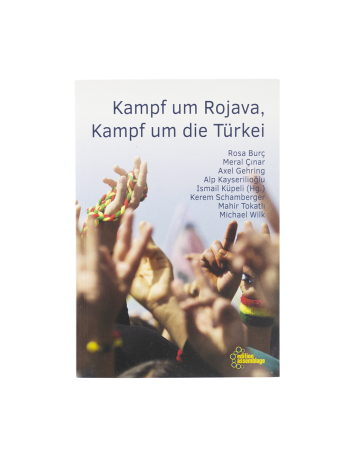
Rosa Burç, Meral Çınar, Axel Gehring, Alp Kayserilioğlu, Ismail Küpeli, Kerem Schamberger, Mahir Tokatlı, Michael Wilk (Authors)
Since its founding in 1923, the Turkish state has denied the existence of the Kurdish population in Turkey and the Middle East. Even today, Turkish domestic and foreign policy aims to prevent the Kurds from exercising political power, both in Turkey and throughout the region. The war in the Kurdish regions of Turkey and Turkey's attacks on the Syrian-Kurdish autonomous region of Rojava are different facets of Turkish policy, which seeks to push the Kurds back throughout the region. While, on the one hand, we can identify considerable continuity between the current policies of the AKP government and those of its predecessors, public debate has simultaneously created the impression that Turkey's policy towards the Kurds has undergone several abrupt and inexplicable shifts in recent years. What remains overlooked is that the AKP conducted the peace process in such a way that the return to war should have come as no surprise. It is also forgotten that the "carrot" of the peace process was always accompanied by the "stick" of massive repression against the Kurds and the threat of war. Through their contributions, Rosa Burç, Meral Çınar, Axel Gehring, Alp Kayserilioğlu, Ismail Küpeli, Kerem Schamberger and Mahir Tokatlı draw attention to connections that receive insufficient attention in public debate. They analyse political and social developments in Turkey, which naturally also includes an in-depth discussion of the women's movement in Turkey. Starting from the central importance of the "Kurdish question", the focus then shifts across the borders of the nation-state to Rojava. On the one hand, the question is raised as to whether Rojava represents an alternative to the nation-state. On the other, the consequences of the Afrin war are examined, both for Rojava and for Turkey itself.
Rosa Burç: Governing Without a State. The Northern Syria-Rojava Federation as a Social Alternative to the Nation-State
Meral Çınar: The Rise of the Women's Movement in Turkey
Axel Gehring: Afrin and the Crisis of the AKP. On the Geopolitics of the Domestic Truce in Turkey
Alp Kayserilioğlu: Victory of the Dictatorship? Turkey After the Afrin Invasion and the 2018 Elections
Ismail Küpeli: As Long as the Kurds Lose: Turkish Middle East Policy
Kerem Schamberger: "We Are the Free Press" – Journalism, Rojava and the Struggle for Afrin
Mahir Tokatlı: Presidentialism à la Turca and the Anti-Kurdish Aspects of the Road to Power
The Editor
Ismail Küpeli is a political scientist and historian. For many years, he has been researching the political situation in Turkey, Rojava and the Middle East.
You might also like